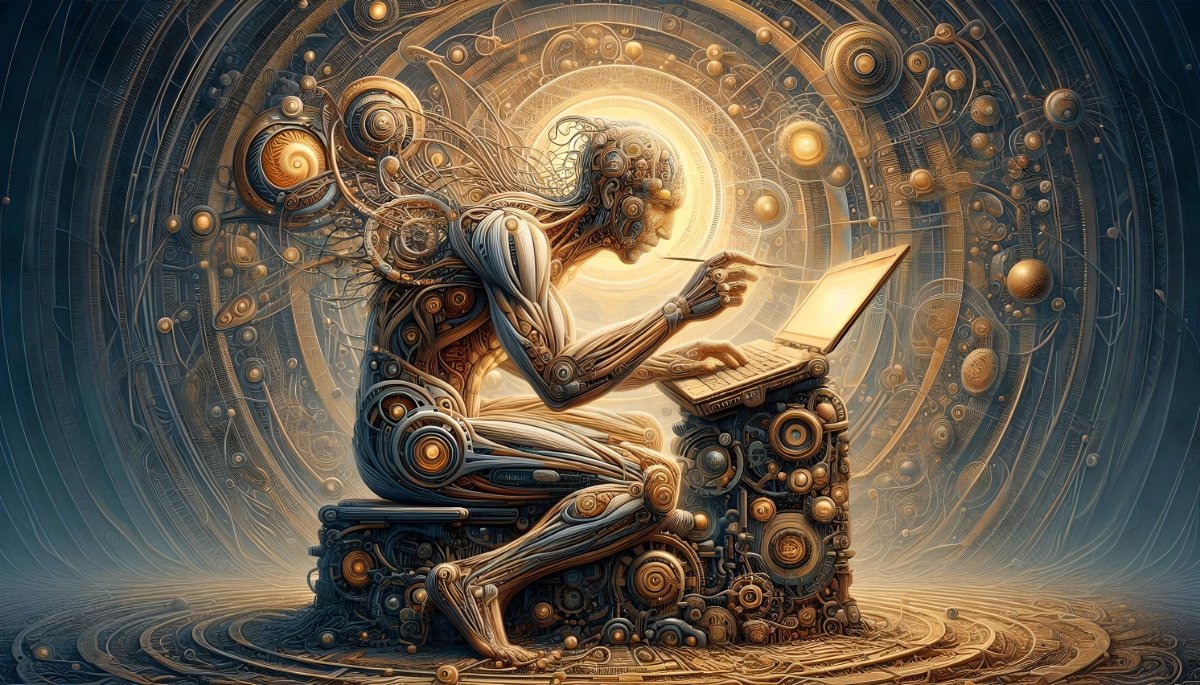
Why are studies of art so reluctant to take up the evolutionary perspective, when it has revived so many other fields? I have a guess, though not a proof: art tends to be guarded as the last enclave of freedom, and the word “instinct” sounds in that house like an attempt to take away its mystery. Does it really take it away? I think not, and I will try to show why.
In The Art Instinct (2009), Denis Dutton derives art from evolution and still does not lock it into a scheme. Among the twelve features by which, in his view, we recognize art are direct pleasure, the potential to express individual personality, and also novelty and the capacity to surprise an audience. What is shared, then, is that people everywhere make things; what differs is how, and from what. I notice, too, how much hangs on a single conjunction: between “art and evolution” and “art versus evolution” lies the whole difference between a dialogue and a quarrel.
The oldest trace of this instinct known to me survives in stone. The Acheulean handaxe, symmetrical, shaped like a leaf or a teardrop, was made for more than a million years (by at least three species of human, according to archaeologists), and Dutton calls this tradition the longest in the history of art. Researchers argue about what that symmetry meant: some see a signal of fitness aimed at potential mates, others simply the pleasure of making, and frankly I do not know whether it can ever be settled. Dutton leans toward the first answer, but a simpler sentence of his stays with me: in something done well we find beauty, and the display of skill is among the most deeply moving and pleasurable aspects of art.
The second trace is quieter, because it leaves no stone. I imagine that around the fire a story carried knowledge: where the water is, who failed, who came back and what they saw. In On the Origin of Stories (2009), Brian Boyd sees in narrative a kind of cognitive play that gave people the belief that the world could be reshaped. There are reviewers who ask whether usefulness exhausts what we love literature for, and I am not sure either. It seems to me, though, that the oldest stories must have been about those who went farther than the rest. The GlassStories microstories about people of science are the same kind of story: about someone who stepped beyond the known, and about what that someone brought back.
Tolkien wrote in Mythopoeia: “The right has not decayed. We make still by the law in which we’re made.” This can be read theologically, and it can be read biologically, and I see no reason why one should exclude the other. There is something in that sentence, however, that instinct alone does not explain: novelty. Dutton counts it among the features of art, but where it comes from seems to me still an open question. I sometimes think the creative process is a small reflection of what happens in evolution: from the joining of two elements something arises that is more than their sum (one plus one makes three), and it is hard to point to the moment when the new quality appeared.
Does the hand that shapes a stone do the same as the hand that talks with a model? Of course not. In both cases, though, the viewer asks the same thing: who chose here? If admiration for skill, and for the trace of a person, is as old as art itself, it does not surprise me that knowing how a work came to be changes how it is judged. Studies mostly show that an “AI” label lowers ratings, though how much depends on the study. That is why I say plainly where I was and where the tool was.
In GlassStories, I write the text of every microstory myself, from the first sentence to the last. The image, film, voice and music I guide through tools, and what stays is my decision. The glass card is for me, if I may risk the comparison, an axe and a fire at once: an object that wants to be beautiful, and a story about someone who went farther.
I make no claim to settling this dispute. The first people to hold those axes probably turned them over in their hands and wondered who had made them.