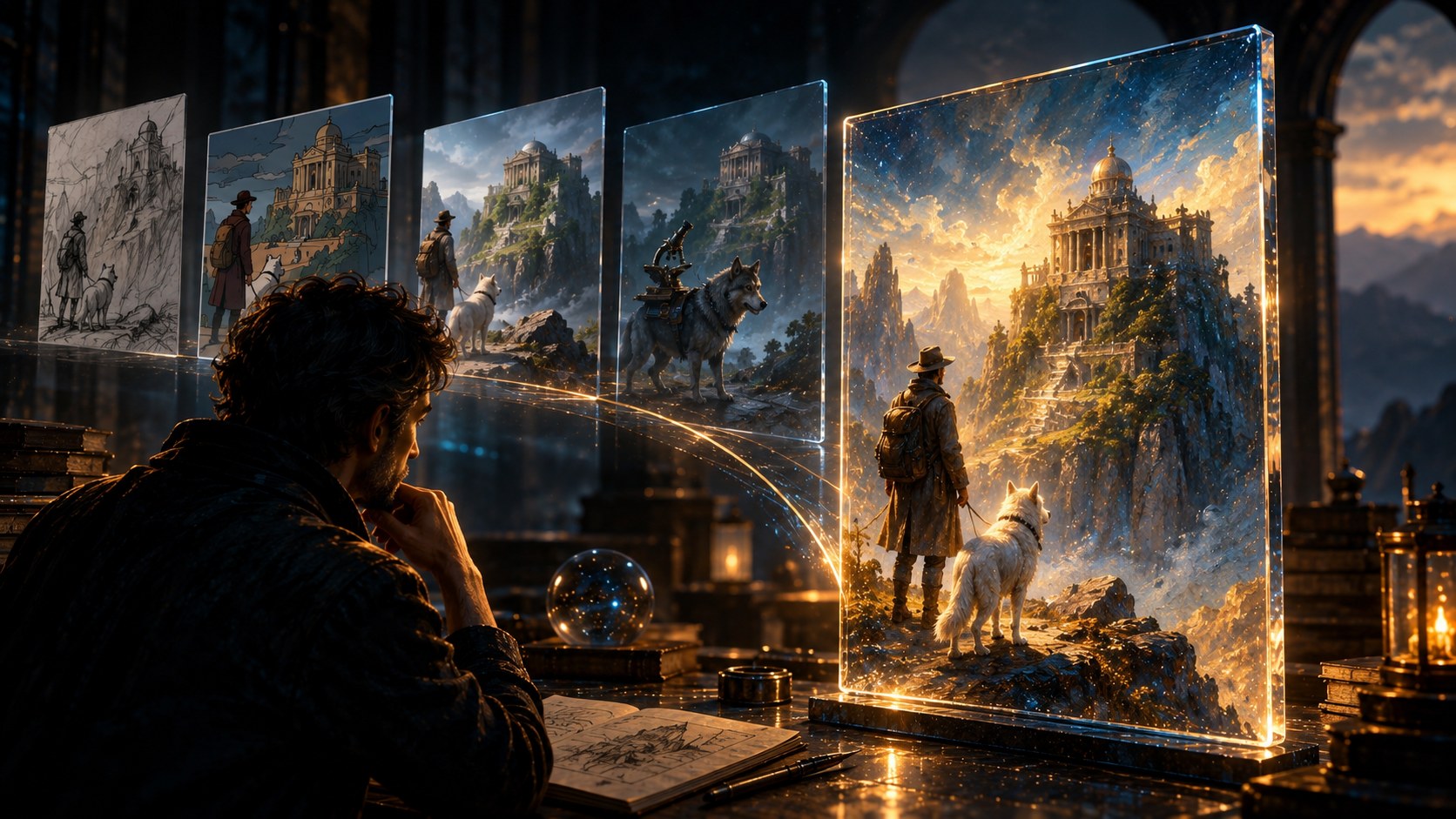
The first version of Santa Fe was correct. A man with a white dog on a leash, a rocky plateau, a temple overgrown with green, a bright day. An architectural visualization in which every stone lies where it should. I rejected it. In the next version the dog became a wolf, and an old microscope sat on its back, but that was only halfway.
For almost two years I searched. Retro comic SF, photorealism, hyperrealistic space stations, the first painterly attempts. I kept discarding styles until what remained was what is now the form of GlassStories: ultramarine and gold, light emerging from darkness, a soft texture in which the image resembles oil more than a screen. I did not pick chiaroscuro from a catalog. It grew out of how my concept of the project's aesthetics matured, and alongside it I was learning the tools: which one suits what, and what you must not expect from it.
I mention this because the question of art made with AI usually comes down to a single objection: the machine has no intention. It seems to me a serious objection, and one that should be heard in its strongest form. A model does not know what it wants to say. It has no childhood to return to at a certain shade of green, it fears nothing, it desires nothing.
Yet photography heard the same objection long ago. In 1859 Baudelaire assigned it a servant's place, as a handmaid of the sciences and arts: the camera takes the picture by itself, a human only presses the shutter. The dispute faded when people noticed that the photographer does decide something: the frame, the moment, what the picture will not show. The question changed. From what the work was made with, to who answers for it.
In GlassStories I answer in two parts. The first concerns the text. Every microstory is written by a human, entirely, from the first sentence to the last. AI is not the author of the content here. The second concerns the image, which comes about differently, in conversation with a model: I describe, I look, I discard, I describe again.
This second part looks like little, but research on creators without art training suggests that this is where the work lies. Zhou and Lee (PNAS Nexus, 2024) analyzed more than four million works from one of the art-sharing platforms. After switching to generative tools, creators' productivity rose by about a quarter, and the value of their works, measured by favorites per view, by half. The key skills turned out to be ideation and selection: devising concepts and choosing from the results those that hold together. Technique moved to the background. I believe the criterion is therefore simple: whether someone answers for every choice.
A snag remains that I do not want to sweep under the rug. People say AI is just a tool, like a brush or a camera. I am not sure that is true, because a brush does not hand me ideas, and a model does, ones we already know. In an experiment with short stories (Doshi and Hauser, Science Advances, 2024), access to ideas from a model raised ratings of novelty and usefulness by about eight and nine percent. The stories also grew more similar to one another. Each writer gained individually, and together they drifted toward the middle. I do not know whether the same happens with images, but I suspect it does. Perhaps that is why I discarded styles for so long, until I found one that no model offers on its own.
There is a second price. According to studies, works labeled as made with AI are sometimes rated lower than identical works without the label. A viewer who knows a model was in the process looks for someone who stands behind the work, and does not always find them. One can respond by hiding. I choose to say plainly where the model was and where I was. Subcreation, as Tolkien wrote, is a gift of the human being. I see no reason to attribute it to a machine, nor to be ashamed that I talk with one.
The card I hold in my hand has an image on the glass that came after a long conversation, and a text I answer for from the first word to the last. I do not yet know whether to call the machine a co-creator of the image. I only know that I would not call it a brush.