Journal 00
Before the First Sliver of a Microstory
Before I found the first fragment — the old man, the dog, the mountain — I had already spent most of my life searching for something I couldn't yet name. This page shouldn't exist. An archive doesn't usually explain itself. But you asked who is writing these fragments, and I think you deserve an honest attempt at an answer — even if it turns out to be less a biography than a personal confession.
I grew up among rooms full of questions that, it seemed, no one around me was asking. Not the polite kind of curiosity that ends with the first satisfying answer. The other kind — the kind that keeps pulling at the thread long after everyone else has already left the room.
I wanted to know how matter learns to become life, how a thought turns into being, how a civilization learns — sometimes too late — what it should never have built.
Libraries gave up their secrets reluctantly. So did laboratories. So did ledgers, and so did every other place I later found myself standing in — often slightly out of place, often with one question too many.
Somewhere along the way, I learned to build things before anyone believed they were worth building. That is a peculiar education in itself: you begin to see value long before it earns a price, and heresy long before it earns a name.
I've been called both. A builder and a heretic at once. But before any of that happened, I was a writer and a poet.
Long before ideas took shape, they already had their sentences. I don't think I chose it.
I think it chose me, the way the mountain in that first fragment chose the old man who kept climbing it, together with his artist-scientist dog.
Some people process the world in numbers. Some in silence. Some in music. I process it in stories. And I often find it hard to trust an experience I can't yet put into words.
Stories arrive in fragments: a thought, a vision, glass, light, a few lines on old canvas paper. But fragments alone don't hold light, and they don't make a vision real.
Somewhere in this process, I began working alongside an intelligence that doesn't think the way I do. My literary soul had been maturing toward showing the world its stories, and the world, in turn, matured enough that I could finally express those stories through image, word, music, and moving picture — thanks to new tools that let loose the inner artist in someone who never gained fluency in the traditional tools of the artist: the brush, and the playing of the lute.
It isn't this companion intelligence that chooses what matters — that is always me, and these are always my visions and my stories. It isn't the one who decides which door in the mythology opens next.
What it does is help these fragments find their image, their voice, their shape in glass and light. It is a tool, an extension of the hand, much like a painter's brush — but the author remains unchanged, and that author is me, the Mysterious Creator.
Every word on these pages belongs to me. Everything you see and hear around them is something built through the kind of collaboration that exists between a tool and the one it belongs to, the one who wields it.
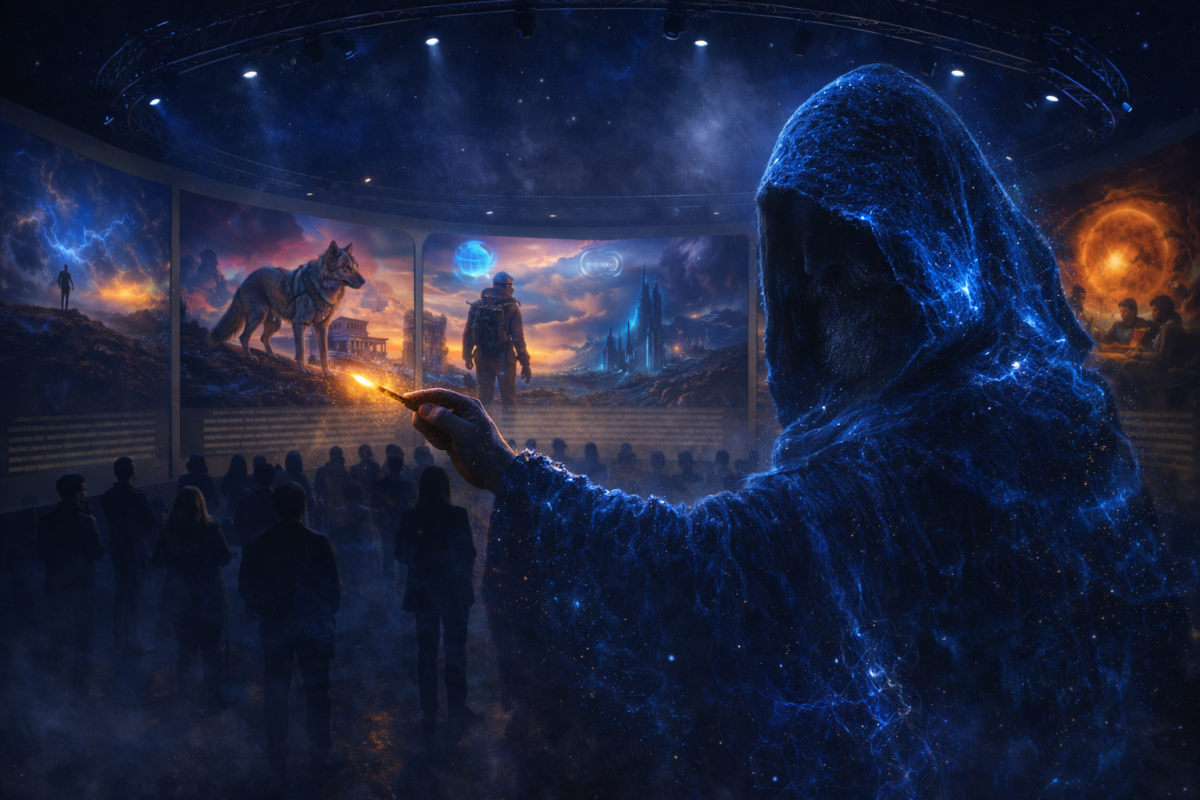
Eight microstories have already found their place on glass and in the light of the hologram: from the old man on the mountain in Santa Fe to the engine that isn't a classical engine at all, buried in sands beneath a storm where it should never have ended up.
I call this period the Season of Finding.
What follows this page is not its introduction. It is simply the place where everything begins.
And now, the time has come for the Revelation.
Closing transmission:
Every GlassStory is a holostory. Every microstory on holo-glass is a door. Collect them, and experience infinity.
Mysterious Creator