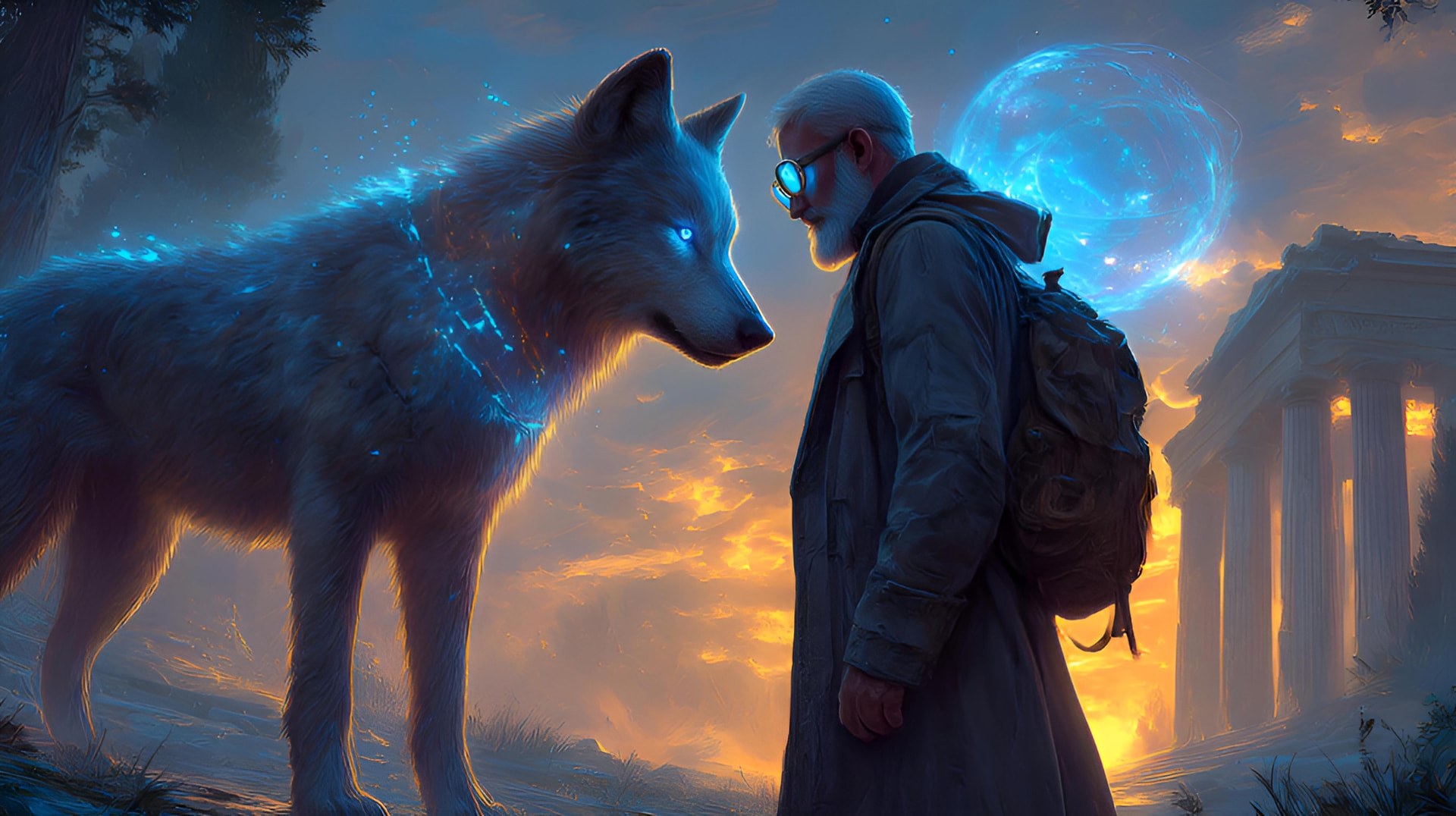
The first version of Santa Fe was made in 2023 and looked like an architectural visualization. A man in a leather jacket and a hat stands on a rocky plateau, holding a large white dog on a leash, and above them, at the top of the mountain, rises a temple with a facade overgrown with green. Sharp peaks, bright day, every texture in its place. The image was correct and entirely silent.
In the manifesto I wrote that stories come to me in fragments. This one came as a mountain that (it seems to me) had chosen an old man and his dog long before I chose it. The mountain and the dog I got from the tool within minutes. The reason this man should go there, I had to look for myself.
I looked for it for well over a year. In that time the image of Santa Fe changed so much that today I can hardly recognize in it the spark from which it was born in my mind: the old man acquired a coat and glasses, then goggles and a backpack full of instruments, the dog became a dark wolf in a harness, with research instruments on its back, and a luminous sphere hung in the sky. I cannot name the day it happened. At some point, I think, I asked who they were, and the image had to answer. Along the way I rejected whole styles, from sixties comics to photorealism. They were well made. None of them knew what the wolf carried on its back.
This experience confirmed my conviction that the rule I keep is the right one. The source is in my mind, yet that source reaches beyond me. I write every sentence of a microstory myself. The images, film, narrator's voice and music are made with the help of artificial intelligence tools, and I guide them and decide what stays. "Human-authored, AI-assisted" describes this exactly, and I prefer it to generalities; besides, anyone can check what here belongs to whom.
Text and image go onto glass because glass has something of a window about it: one looks at it and through it at the same time. Every story is released in 199 numbered copies, with a "Certified Original · No. X of 199" certificate.
Why do scientists, research and science run through the microstories? Because the lives of these fascinating people have what I could not have invented better myself: stubbornness, mistake, chance and courage in the face of institutions. In Santa Fe it is an institute of outsider and rebel researchers. In Non sine periculo, people and artificial intelligences build a new sun, and the visionaries are called heretics by some, saviors by others. Many real scientists were called the same, depending on who was looking and in which year.
Tolkien called this sub-creation, the making of secondary worlds. I lay no claim to so lofty a name, but it seems to me the direction is right.
Creating worlds is the essence of life. Experiencing them gives its meaning.
The white dog on a leash stayed in my archive, so that I remember where I began. The wolf carries the burden of research and creation onward.