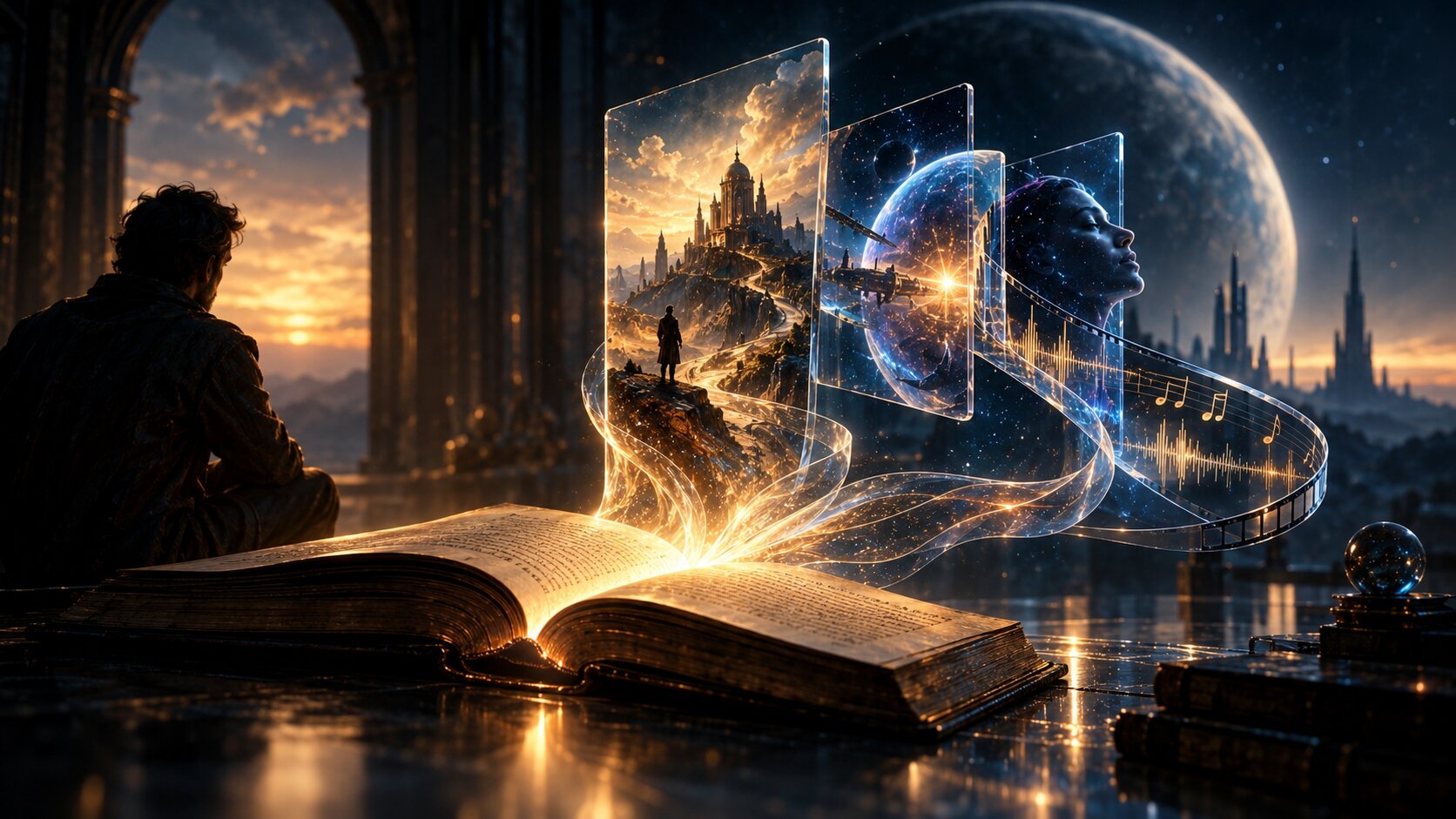
In "After Writing", Jacek Dukaj calls writing a god "greedy and jealous": you cannot have other gods. I read this sentence as a diagnosis, not as a verdict.
For several thousand years, writing truly did not tolerate competition. Everything that could be told had to fit into a line of letters, and the rest was left outside: voice, light, rhythm, image. These lived elsewhere, in the theatre, in song, in an illustration in the margin.
Dukaj does not conclude that reading has lost its meaning. Asked whether it is worth learning, he answers yes, but for a different reason than a generation ago. Knowledge can now also be gained through experience, so writing is no longer the only way in. What remains is a capacity that no other path gives so easily: the ability to stay with a long mental effort, against stimuli that keep trying to scatter our attention.
Yet image and sound came before writing. Stories lived for a long time in the voice, in the gesture, in the light of a fire. Dukaj himself reminds us that, from the point of view of neuroscience, reading and writing are acrobatic feats, not a natural ability of the brain. The inclination to think and to live through images and sounds seems, then, to be something that the culture of writing covered over rather than eliminated.
This does not make the post-writing age a return to what was before writing. The difference I am trying to capture goes like this: once, an experience happened one time, in one place, and depended on the storyteller. Today it can be preserved, repeated, and above all arranged around a text that one can read alone, in silence. Writing is not the adversary here. It is the core.
This is how the GlassStories.art collection is shaped. Every story begins as a microstory, a short text that can be read from beginning to end in a minute or two. The film, the artwork, the music and the narrator's voice grew around it, so that it could be lived, not replaced. A glass card in the hand, light breaking through the image, the same text spoken in another voice after you have read it yourself.
A microstory has one advantage: you can read it to the end in a fairly short time. Reading seems like little, yet Dukaj suggests that a great deal depends on exactly that little.
The jealous god remains a god. He simply has guests at the table now.