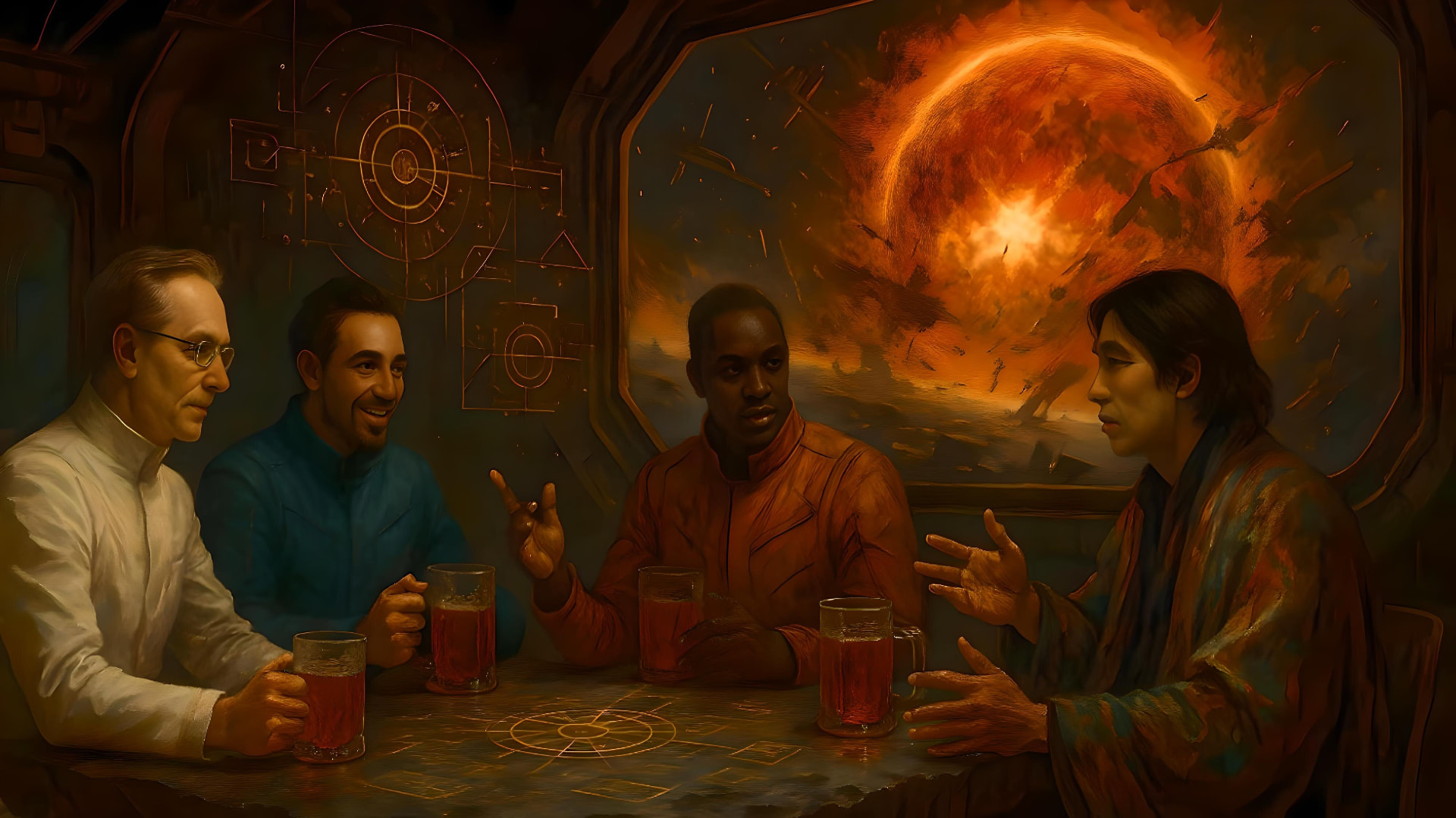
Do most of the conflicts we live through come from a difference in reasons — or a difference in language?
"I have the feeling that we are talking about the same solution to our civilization's burning solar problem — literally and figuratively speaking — only in very different languages."
I remember a conversation from years ago, in which I said something meant to mean one thing, and it was heard as something else entirely. To this day I'm not sure whether we disagreed on the substance, or only on the language we were trying to understand each other with. This fragment from the old canvas notebook, which I hold in my hands today, speaks of exactly the same problem — only on a larger scale, at a table carved from a meteorite fragment, over mugs of red beer, in the shadow of a dying Sun.
Four men. Different cultures, different disciplines, one problem: how to build a star to replace the one that's dying. One of them says it plainly: I have the feeling we're talking about the same solution, only in very different languages. Another replies that their informal assembly is paid precisely to negate — to reject projects that show no promise. And he adds something that stopped me for a long while: I'm afraid that through stubbornness and misunderstanding, we'll negate each other and end up with no solution at all.
How many times in my life have I been that voice of negation, out of habit rather than conviction? How many times has someone been that voice toward me? I think most of the conflicts we live through don't come from genuinely opposing views, but from errors in translating one mind into the language of another. A physicist and a theologian, an engineer and a quantum mechanic, me and you, reader of this journal. Every speaker carries a dictionary the other will never fully learn.
And yet those four reached an agreement. Not because they stopped differing, but because someone, in the end, said out loud what everyone had already been thinking. Maybe agreement doesn't require one shared language. Maybe it only requires a moment in which someone dares to name what everyone already felt, before anyone had the words for it.
Tonight I'm drinking something that isn't Martian beer, but I raise my glass toward them anyway. To those who can translate silence into understanding before it's too late.
Closing transmission
Every glassstory is a holostory. Every holostory is a door. Keep collecting them and experience the infinite.