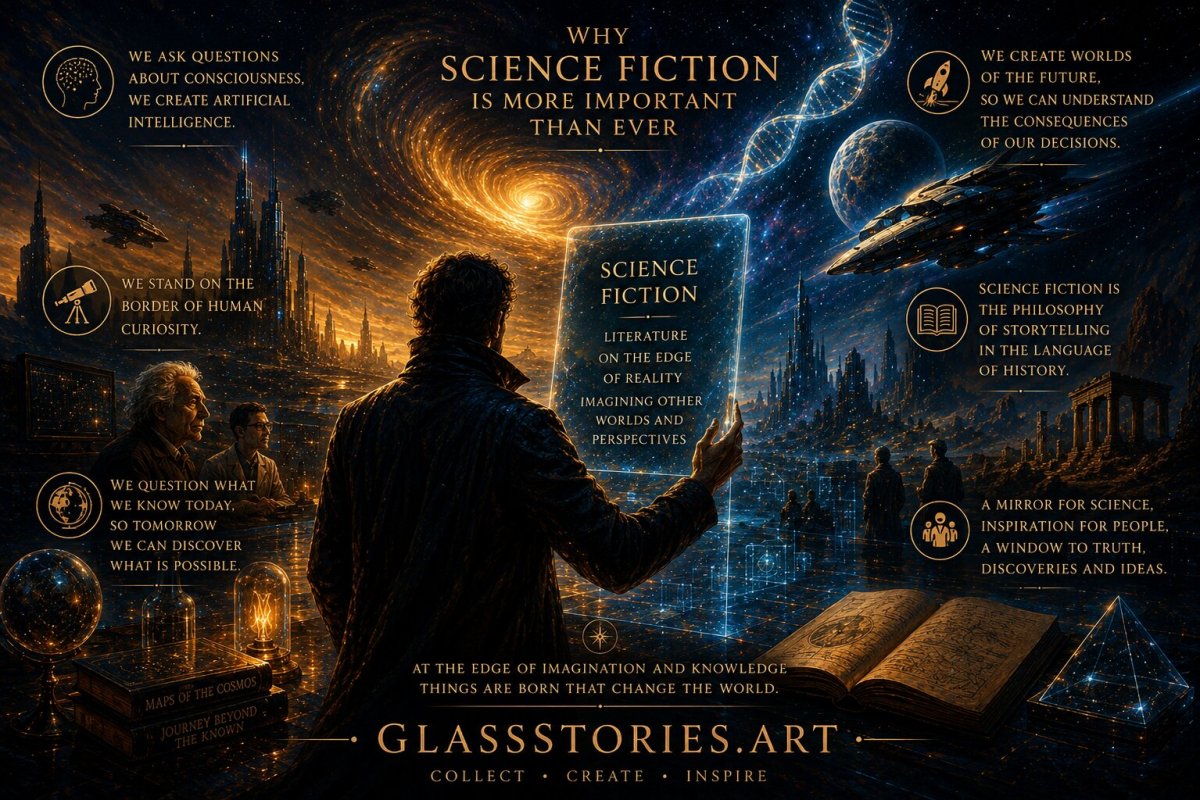
Sometimes I hear that science fiction is literature about the future. I am not sure that is right. Ursula K. Le Guin wrote, in her introduction to The Left Hand of Darkness, that science fiction describes rather than predicts, and the longer I write the truer that remark seems. Good science fiction is literature about the present, seen from a different angle.
When we write about artificial intelligence, we are asking about the nature of consciousness. When we tell of interstellar travel, we are looking at the limits of human curiosity. When we draw future civilizations, we are trying to understand where our decisions today may lead. Science fiction is a thought experiment dressed as a story, which is how it earns a place beside philosophy.
At a time when technology is changing the world faster than ever, we need such stories. They let us rehearse the consequences of things that are only beginning to appear.
In GlassStories, science fiction has another task. It is a mirror held up to science. I picture a pane of dark glass with a lit room behind it, where you see your own face and the stars at the same moment. Many of these stories are inspired by real scientists, discoveries and ideas that are already changing how we think about the world.
That may be why I am drawn to this form. It stands at the boundary of two worlds, imagination and knowledge, and it seems to me that the most interesting things in human history were made at such frontiers.