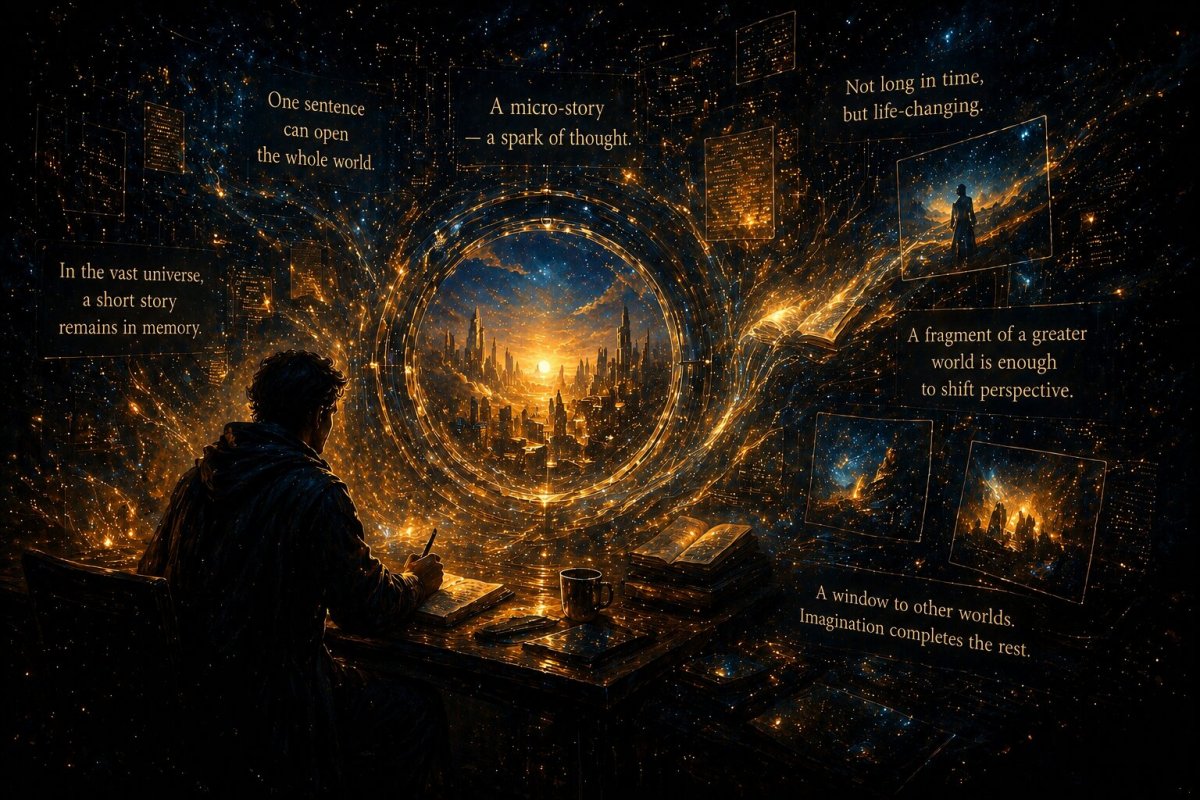
We live in an age of excess. A stream of articles, images, videos, messages and news passes through our minds every day, and in that stream it is hard to hold attention for long. The paradox is that this is exactly the moment to value forms that are short and dense with meaning.
Humanity has loved such forms for as long as it has told stories: the fable, the parable, the haiku, the inscription on a gravestone. A microstory belongs to that family. It is a concentrate of thought. There is no room for long introductions or elaborate description, so every sentence has to work and every image has to matter. I have grown fond of the constraint, the way a sonnet writer is fond of fourteen lines.
I like to think of a microstory as a spark. A spark is small, and it can start a fire.
In science fiction the form has one more gift. It lets me show a fragment of a larger world, a moment, a scene, a situation, without describing the whole universe. The reader supplies the rest, and in doing so becomes a co-author of that world. A single sentence can open more space than a page of description.
A glass card fits in one hand, cool against the skin, and the story fits on the card. The microstories of GlassStories.art are fragments of futures that may or may not come. They offer a window where a history of civilizations would need a library, and one such window can be enough to see something that changes the way we think about reality.